 Los Altos Sub-Zero Appliance Repair
A display alarm on our 648PRO had me fearing a compressor. They verified the sensor and voltage readings first and it turned out to be a failed thermistor, not the sealed system. They proved it was the small fault before quoting anything big.
Home / Los Altos Sub Zero Control Board Vs Sealed System: evidence-first Sub-Zero guidance
Sub-Zero firstLos AltosBoard vs sealed hub
Los Altos Sub Zero Control Board Vs Sealed System: evidence-first Sub-Zero guidance
A Los Altos Sub-Zero alarm or warm cabinet should not be quoted as a control board or compressor repair until sensor readings, airflow, electrical checks and temperature pattern are documented. Control and sealed-system symptoms can overlap, especially when condenser airflow, door sealing, fan operation, defrost behavior, or actual compartment readings have not been verified.
- Board clues
- Sensors, voltage, display
- Sealed clues
- Recovery, leak, pressure
- First rule
- Verify basics
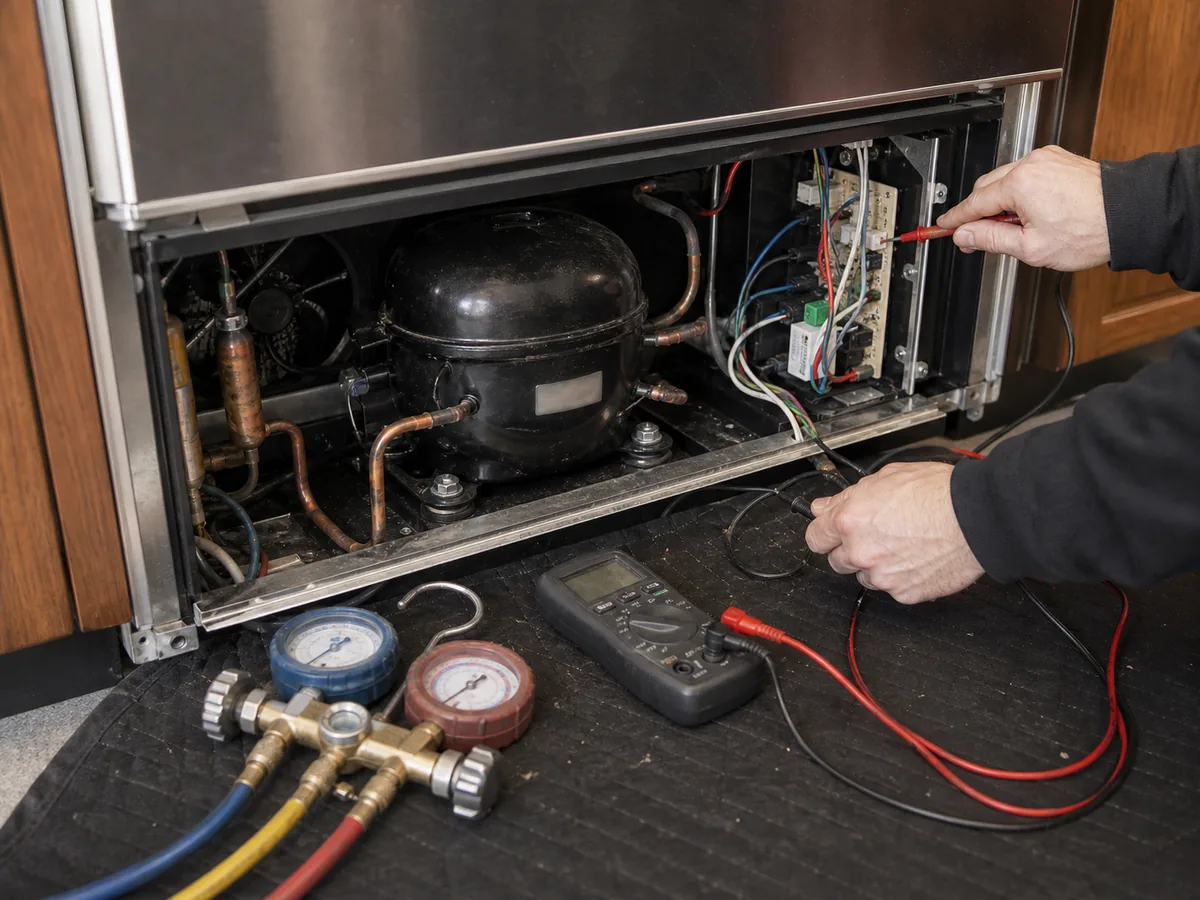
How do I know if my Sub-Zero needs a control board or a sealed-system repair in Los Altos?
Los Altos Sub-Zero Appliance Repair documents sensor voltage, fan operation, frost pattern and compartment recovery before quoting either path for Country Club homes near 94022, because an alarm label alone proves nothing; phone (650) 668-1043 to book that evidence-first Los Altos diagnosis.
Customer reviews
What Los Altos homeowners say
They tested the board with a multimeter instead of guessing, then replaced the electronic control board only after the readings confirmed it, and documented the recovery temperatures afterward. Exactly the kind of diagnosis you want on an expensive unit.
Ours genuinely was a sealed-system fault. They confirmed the leak with proper gauges, repaired and recharged the system, and walked me through the before-and-after pressures. They were clear about why it was not just a control board.
Direct answer continued
What this usually means
A control board can fail, but it is not the answer to every alarm. A sealed system can fail, but it is not the answer to every warm cabinet. The two paths must be separated by documented readings: actual temperatures, sensor behavior, airflow, fan operation, defrost condition, condenser load, voltage checks, compressor run behavior, and model-specific logic.
For Los Altos built-ins, cabinet access also matters. A major quote may require movement, protection, and a repair-vs-replace conversation.
Required table
Alarm or symptom to board clue and sealed-system clue
| Alarm / symptom | Board or sensor clue | Sealed-system clue | Evidence required before quote |
|---|---|---|---|
| Warm cabinet with display alarm | Sensor drift, fan fault, board input issue | Poor recovery after airflow and electrical checks pass | Actual temperatures, display photo, model tag, fan/airflow tests |
| Fresh-food warm, freezer holds | Damper, fan, thermistor, defrost control | Less likely unless recovery evidence points beyond zone fault | Compartment split, frost pattern, fan operation |
| Both compartments warm | Control not starting compressor or fans | Condenser fan, low charge, compressor, leak | Electrical checks, condenser airflow, pressure/leak evidence |
| Long run time after condenser cleaning | Sensor misread or control logic issue | Weak compressor or refrigerant issue | Probe readings, run behavior, sealed-system verification |
| Repeated alarm after power event | Board reset, sensor, door switch, display module | Only if temperature trend confirms cooling loss | Time of event, recovery log, voltage/control checks |
Do not skip basics
False positives before expensive quotes
| False positive | Why it misleads | First test |
|---|---|---|
| Dirty condenser | Can look like weak compressor because heat cannot leave the cabinet. | Clean/verify airflow before sealed-system quote. |
| Door or panel not sealing | Can create frost, alarms, and long run time. | Check gasket and alignment before board quote. |
| Warm grocery load or door event | Can trigger alarms without a failed part. | Log recovery instead of replacing controls immediately. |
| Unverified display reading | Can differ from actual compartment temperature. | Use probe comparison before sensor/control replacement. |
Approval standard
Evidence required before quote
| Quote type | Evidence that should exist | What should be written |
|---|---|---|
| Control board or display | Voltage, connector, sensor, service-mode, and model/serial evidence. | Which control failed and why similar symptoms were ruled out. |
| Sensor or thermistor | Probe comparison, resistance readings, and compartment trend. | Which reading was wrong and how recovery will be verified. |
| Fan, defrost, or airflow repair | Fan operation, frost pattern, heater/sensor path, and actual airflow. | Why airflow explains the temperature pattern. |
| Sealed-system or compressor | Airflow basics ruled out, pressure/leak/electrical evidence, and recovery plan. | Why sealed work is justified and what replacement comparison was discussed. |
Los Altos risk
Local notes
Old Los Altos remodels can hide condenser airflow behind custom trim. North Los Altos high-use kitchens can make long run time look more severe until airflow and door-open patterns are checked. Country Club and Loyola Corners homes may have panel-ready columns where access and replacement disruption should be part of a major quote. In every neighborhood, the board-vs-sealed decision should be documented before expensive work is approved.
Major-repair limits
When not to guess
Do not replace a board because a display alarm exists. Do not quote a compressor because both compartments are warm without first checking condenser airflow, fans, controls, and cabinet ventilation. Do not add refrigerant as a shortcut. Ask for the evidence file before approving major work. And because the sealed path is refrigerant work, verify the EPA 608 credential of whoever opens the sealed system before that approval is given.
Explore more
Related pages
For a complete answer, connect this page with Sub-Zero repair cost in Los Altos, Sub-Zero not cooling in Los Altos, model-first diagnostics, cabinet-safe built-in service, Los Altos route notes, and call or book online.
Visible Q&A
Questions this page answers
How do you tell a control board problem from a sealed-system problem?
A control board problem and a sealed-system problem are separated by evidence, not by a single alarm label. Sensor readings, voltage checks, fan operation, airflow, frost pattern, and compartment temperature trend all matter. Sealed-system conclusions should wait until basic electrical, airflow, defrost, gasket, and control clues are documented.
Can an alarm mean the compressor is failing?
An alarm can be consistent with compressor trouble, but it can also be caused by door events, dirty condenser airflow, sensor drift, fan failure, defrost trouble, or a control fault. The model and serial number determine how the alarm should be interpreted. Ask for tests before approving a compressor quote.
Is the refrigerator warm but freezer cold a compressor problem?
A fresh-food section that is warm while the freezer is cold is not automatically a compressor problem. The first test is usually airflow, evaporator fan, defrost, thermistor, gasket, and cabinet ventilation. Compressor or sealed-system work should be discussed only after basic zone-specific evidence fails to explain poor recovery.
Why does the model and serial number change a Sub-Zero quote?
The model and serial number can change the part path because similar Sub-Zero symptoms may use different gaskets, fans, boards, valves, sensors, or sealed-system components. That matters most on panel-ready and older built-in Sub-Zero refrigerator installations. Have ready a readable tag photo so the estimate does not rely on appearance alone.
What should I have ready before booking?
Have ready one readable model and serial number photo, one wide cabinet photo, current fresh-food and freezer temperatures, and a close symptom photo. If there is an alarm, include the display. If there is frost, condensation, hollow ice, or a dirty condenser, photograph it before resetting or cleaning away evidence.
How do I schedule Sub-Zero service in Los Altos?
Call (650) 668-1043 or use the online booking link to request a Los Altos Sub-Zero appointment. Have your model and serial number, current temperatures, and a wide cabinet photo ready so the technician can plan parts and access before arriving.
Should I replace or repair an older Sub-Zero in Los Altos?
Repair usually makes sense when the failure is isolated, parts are available, and the cabinet opening would be expensive to change. Replacement becomes more reasonable when parts are unavailable, repeated sealed-system work has failed, or a remodel is already planned. Compare the repair quote with cabinet, panel, delivery, and downtime costs.
Call or book online
Schedule Sub-Zero service
Model, serial number, and diagnostic evidence determine the final quote, so the estimate is built on what is actually confirmed at the appliance.
Call (650) 668-1043 to schedule Sub-Zero service in Los Altos, or book online (opens in a new tab).
Price table
Control-board vs sealed-system repair costs
The two paths sit far apart on price, so evidence matters. These ranges separate the electronic repairs from the sealed-system work.
| Service | What it covers | Price range | Time |
|---|---|---|---|
| Diagnostic visit | Sensor, voltage, airflow, and recovery readings | $185-$295 | 45-90 min |
| Thermistor / temperature sensor | Drift or miscalibration | $260-$580 | 1-2 hrs |
| Electronic control board | Board fault confirmed by test | $560-$1,450 | 1-4 hrs |
| Evaporator / condenser fan | Airflow fault | $295-$760 | 1-2 hrs |
| Sealed-system leak & recharge | Leak locate, repair, evacuate, recharge | $1,800-$3,200 | 3-6 hrs |
| Compressor replacement | Compressor, drier, recharge | $2,400-$4,800 | 4-8 hrs |
What sets the final price: whether sensor, voltage, and airflow tests explain the fault before any sealed-system or compressor quote.
Service facts
Board vs sealed-system facts
- A control or sensor repair typically runs $260-$1,450, while sealed-system work runs $1,800-$4,800, so the diagnosis decides the budget.
- An alarm alone does not confirm a compressor; sensor, voltage, and airflow tests come first.
- Sealed-system conclusions wait until basic electrical, airflow, defrost, and control evidence is documented.
Related reading
Worth a look before you book in Los Altos
- What Sub-Zero alarms actually tell a technician - codes are clues that still need model-specific verification.
- When sealed-system suspicion is justified - the verification standard for the expensive path.
- Find the model and serial number first - serial breaks decide which board or sealed-system part fits.